Herodotus in Translation: Which to Pick?
If you are wondering which translation of the Histories you should grab for the read-along, you are spoiled for choice. No translation is any wronger or righter than any other; they’re simply readable or unreadable, and that is a personal preference.
Below, you will find the list of currently-/easily-available translations, as well as the opening proem (from the Greek προοίμιον/prooimion for “before the song,” which is just lovely in my opinion — feel free to try to get a proem renaissance going in your own home).
Whichever translation feels the easiest/more pleasant to read, go with that one. You will not go wrong, he said, tempting the Fates.
And a reminder: If you want to participate, but can’t put your hands on a copy, let me know. I have several extras, and at least one other member of the group has said he also has extra copies.
Tom Holland (2015)
Notes by Paul Cartledge (2015)
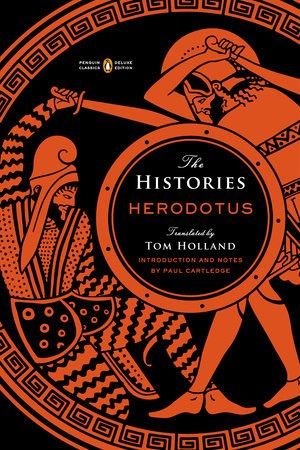
Herodotus, from Halicarnassus, here displays his enquiries, that human achievement may be spared the ravages of time, and that everything great and astounding, and all the glory of those exploits which served to display Greeks and barbarians alike to such effect, be kept alive – and additionally, and most importantly, to give the reason they went to war.
Pros: Very easy to read. Readily accessible language. The physical book itself, if you are reading a physical book, has a mighty fine heft to it.
Cons: Paul Cartledge’s notes are somewhat lacking. There are places in the text where something extraordinary will have been described, and, if Cartledge has even bothered with an endnote, it is for something unrelated to the thing that likely made you stop in your tracks and say, “They did what?”
Andrea L. Purvis (2009)
The Landmark Herodotus, ed. Robert B. Strassler, introduction by Rosalind Thomas
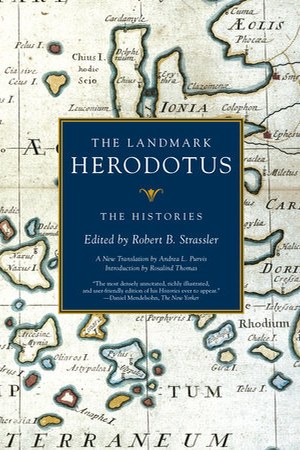
Herodotus of Halicarnassus here presents his research so that human events do not fade with time. May the great and wonderful deeds — some brought forth by the Hellenes, others by the barbarians — not go unsung; as well as the causes that led them to make war on each other.
Pros: This is from the Landmark series of Ancient Greek texts. They are, without a doubt, thoroughly foot-, end-, and side-noted. If you are worried you might miss important cultural context, the Purvis translation in the Landmark Herodotus is what you will want.
Cons: However, all of that great scholarship and context comes at a physical price: the book is a non-standard 7.5/9.25. It’s not a curl-up-in-bed edition, and it is quite heavy.
Robin Waterfield (1998)
Notes by Carolyn Dewald (1998)
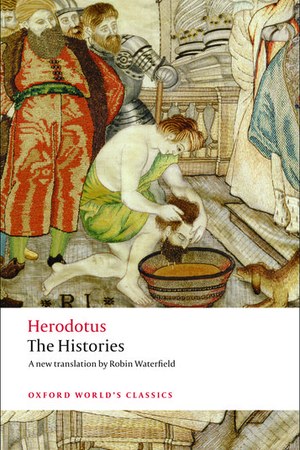
Here are presented the results of the enquiry carried out by Herodotus of Halicarnassus. The purpose is to prevent the traces of human events from being erased by time, and to preserve the fame of the important and remarkable achievements produced by both Greeks and non-Greeks; among the matters covered is, in particular, the cause of the hostilities between Greeks and non-Greeks.
Pros: Like the Holland, very easy to read. The notes by Carolyn Dewald are very excellent. If Holland’s translation could make or adopt a baby with Waterfield, that child would be the best current translation of the Histories for my money.
Cons: I feel as if I should try to list at least one con. I currently am not aware of any. But I also don’t want that to come across as a blanket endorsement.
Aubrey de Sélincourt (1954)
Notes by John Marincola (1996, 2003)
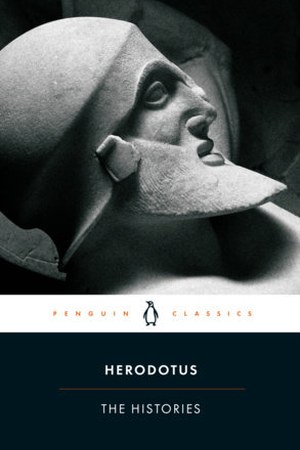
Herodotus of Halicarnassus here displays his inquiry, so that human achievements may not become forgotten in time, and great and marvellous deeds – some displayed by Greeks, some by barbarians – may not be without their glory; and especially to show why the two peoples fought with each other.
Pros: It is book-shaped and book-dimensioned, so you can tuck into it easier if you are a bedtime reader. De Sélincourt spent a lifetime with Herodotus (not literally), so reading his translation is a bit like hearing Herodotus from one of his best friends.
Cons: This is a mid-20th-century translation and (close your eyes and think of England, Gen Xers and older) already pretty dated. De Sélincourt’s prose is a little more stilted and formal than the Holland (especially) or the Waterfield. If you don’t feel as comfortable with “old” books, this may not be the best translation to start with.
George Rawlinson, translation and notes (1858–1860)
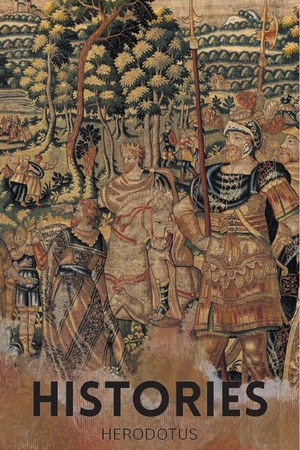
These are the researchers [typo in the Rawlinson; it should be researches] of Herodotus of Halicarnassus, which he publishes, in the hope of thereby preserving from decay the remembrance of what men have done, and of preventing the great and wonderful actions of the Greeks and the barbarians from losing their due need [typo in the Rawlinson; it should be meed] of glory; and withal to put on record what were their grounds of feud.
Pros: The cover is absolutely gorgeous. Even if you never finish the book, you should leave it casually on a table where others can see and you can say, “Oh, that? Just a bit of Herodotus.” (I love the Rawlinson, but I also am a Victorianist at heart.)
Cons: Rawlinson was a Victorian, and his translation reads like a Victorian translation. The diction is geared more toward the romantic and poetic, which, for anyone not well-read in the 1800s could cause you more difficulty your first time through Herodotus than is fair to you.
More important than the archaic text is the fact that, at least in the Wordsworth Press edition, there are several copy errors. One example, here in the proem: Wordsworth has “losing their due need of glory,” when it should correctly be “meed of glory.” Meed is an archaic word for a deserved reward.